Frisbie Bets on Economic Message in Key Michigan House Battleground
- May 11, 2026
- 0
State Rep. Steve Frisbie says affordability, tax relief and local control remain the defining issues for voters in exclusive interview.

State Rep. Steve Frisbie says affordability, tax relief and local control remain the defining issues for voters in exclusive interview.

No chamber better reflects Michigan’s sharply divided political landscape than the State House, which has flipped twice in the last four years — from Republican control, to a Democratic trifecta in 2022, and back to a narrow Republican majority following the 2024 election.
Few districts embody that political tug-of-war more than the 44th House District, where Republican State Rep. Steve Frisbie secured victory by just 79 votes in one of the closest legislative races in the state.
Now entering his first full term in Lansing, Frisbie is betting on kitchen table issues to propel him to re-election in a cycle where Republicans are widely expected to underperform relative to 2024.
When asked what is at stake if control of the State House shifts, Frisbie summarized the divide as one between a “common sense versus an agenda of government taxing and spending.”
The 44th district reflects a politically divided cross-section of Michigan, blending Battle Creek-area suburban neighborhoods with rural townships and working-class communities where affordability and local economic issues dominate political debate.
To that end, Frisbie has touted his ability to work across the aisle to deliver on economic issues, including sponsoring a bill to eliminate state property taxes. “You won’t find my former state representative and opponent for the second time supporting tax cuts or more responsible budgeting”, he said.
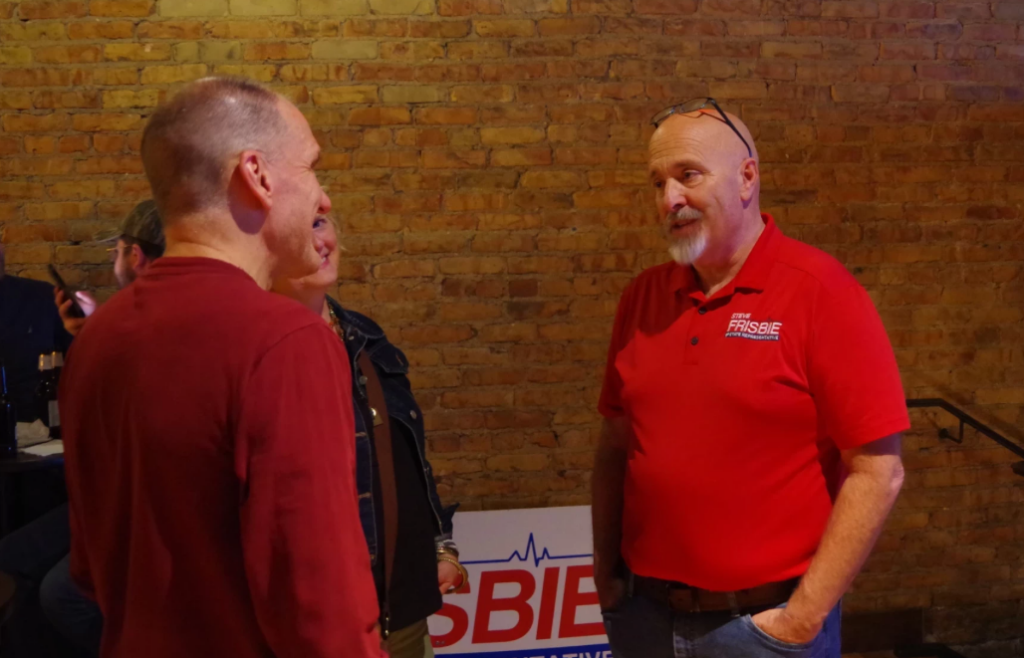
Frisbie is set for a rematch against former Democratic State Representative Jim Haadsma, who is betting that he can reclaim his seat in a down year for Republicans.
Haadsma faced scrutiny for allegedly covering up a sexual assault by a prominent Michigan union organizer in 2023, an accusation that could resurface during the 2026 election cycle.
Frisbie, though, has kept his re-election campaign focused on economic issues and shown a willingness to work across the aisle to deliver for his constituents.
“Most of the bills I submit for consideration have had bipartisan support as co-sponsors. It helps make Senate passage a consideration. Good policy can result from working together.”
Frisbie said frustrations with federal and state policy decisions motivated him to seek elected office, such as the Affordable Care Act and poor governance when Democrats won a trifecta in 2022.
“In 2023, bad policy decisions by the Democrat trifecta bubbled up the same level of disappointment.”
Realizing that he will face a tough re-election, Frisbie has leaned in to listening to his constituents on issues that have not been prominently featured in state/national news.
One such issue, he said, was a loss of local control over approval for alternative energy projects.
Democrats faced significant pushback in late 2023 after passing a bill that allowed utility companies to route around local zoning authorities for renewable energy projects, something that Republicans have pushed to reverse since regaining control of the House.
While national Republicans and Democrats continue battling over immigration, gender politics and other cultural flashpoints, Frisbie’s message more closely resembles the old political adage: “It’s the economy, stupid.”
There is plenty of money already in Lansing — we just need to prioritize spending and live within our means, just like everyone else must do,” Frisbie concluded.
[RELATED: Key Michigan Auto Executive Says State is ‘headed in the wrong direction’]
[RELATED: Major Whitmer Donor Charged with Multiple Felonies Related to $20M Grant]